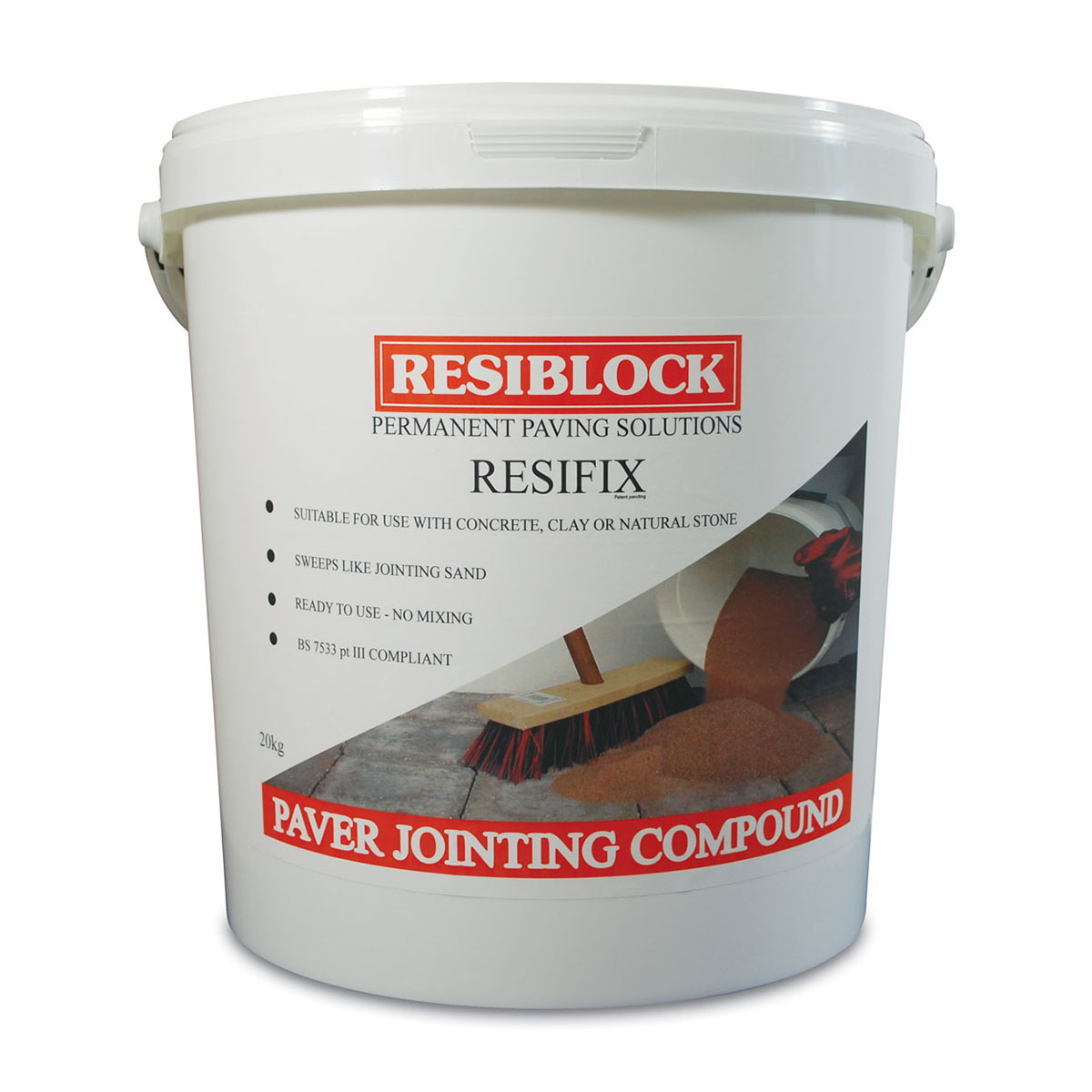
Application Summary
Quick-reference guide — Resifix is a dry jointing sand, not a liquid sealer
Spread Resifix evenly, sweep into joints with a sand squeegee, then compact with a rubber-soled plate compactor. Repeat until joints are full.
Carefully remove all excess Resifix from the paver face and down to the bottom of the chamfers. Excess left on the surface will be difficult to remove once set.
Activate the system by flooding with a hosepipe set to spray. Do NOT use a pressure washer. Ensure joints are fully saturated. Repeat if necessary.
Full Application Instructions
Step-by-step guidance from surface preparation through to activation and curing
- Resiblock Sand Squeegee
- Rubber-soled plate compactor
- Stiff brush or broom
- Hosepipe set to spray (not a pressure washer)
-
1Spread Resifix evenly over the paved surface
Spread Resiblock Resifix evenly across the paved surface in the same manner as conventional kiln-dried jointing sand.
-
2Sweep into joints with a slight pounding motion
Using a Resiblock Sand Squeegee, sweep Resifix into the joints with a slight pounding motion to encourage penetration. Work methodically across the surface.
-
3Compact with a rubber-soled plate compactor
Once a substantial area of paving has been swept, use a rubber-soled plate compactor over the pavers in overlapping passes. Brush more Resifix into the joints and compact the same area again. Continue this procedure until all joints are full and Resifix can no longer be vibrated into them.
-
4Remove all excess from paver faces and chamfers
Carefully remove all excess Resifix from the face of the pavers and down to the bottom of the chamfers. Excess Resifix left on the surface will be difficult to remove once the system has been activated.
-
5Activate by flooding with a hosepipe set to spray
Remove final traces of Resifix and activate the system by flooding with water using a hosepipe set to spray. Ensure all joints are thoroughly saturated. Repeat the process where water has not been fully absorbed into all joints. Do NOT use a pressure washer.
Full drying time is 72 hours at 20°C. Curing time is dependent on climate and the moisture level in the pavers. When dry, Resifix is solid. When wet it remains flexible, allowing small elastic deflections which prevent paver destabilisation.
Technical Datasheet
Product description, spread rates, performance data and storage information
| Property | Specification | Notes |
|---|---|---|
| Product Type | Self-binding polymeric jointing sand | Conforms to BS7533 Part III and Part IV |
| Suitable Substrates | Concrete, clay or natural stone pavements | Standard CBP (2–3mm joint) and wide joint flags |
| Not Suitable For | Ports, airports, commercial vehicle areas, vehicle refuelling areas | Use Resiblock '22' for heavy duty applications |
| Coverage | Identical to conventional kiln-dried jointing sand | Varies by paver size and joint width — see spread rate table below |
| Recommended Joint Width | 2–3mm (standard); also suitable for all width joints | |
| Set Characteristics | Dry: solid. Wet: flexible. | Allows small elastic deflections to prevent paver destabilisation |
| Full Cure | 72 hours at 20°C | Dependent on climate and moisture level in pavers |
| Foot Traffic | Immediately after activation | Ideally leave to dry before use |
| Cleaning Regimes | Avoid for 28 days | |
| Pressure Washing | Withstands pressure washing once cured* | *Lance 200mm from surface, pressure 150 psi — 100x200x60 CBP |
| Min Temperature | Above 5°C | Do not apply if temperatures expected to fall below 5°C |
| Flash Point | Not applicable | |
| Tool Cleaning | Water — wipe immediately | |
| Shelf Life | 12 months (unopened) | 12 months from date of purchase |
| Storage | Store under cover and protect from moisture | |
| Pack Size | 20kg polybuckets | |
| Shipping | Not classified as hazardous material for transportation |
Coverage varies by paver size, depth and joint width. Rates below are offered as a guide only — actual coverage can only be determined by site trial.
| Paver Size | Depth | Joint Width | Coverage (m² per 20kg) |
|---|---|---|---|
| 300 x 300mm | 35mm | 3mm | 14.5 m² |
| 300 x 300mm | 35mm | 6mm | 7.5 m² |
| 300 x 300mm | 50mm | 3mm | 10.1 m² |
| 300 x 300mm | 50mm | 6mm | 5.1 m² |
| 300 x 600mm | 35mm | 3mm | 18.0 m² |
| 300 x 600mm | 35mm | 6mm | 9.0 m² |
| 300 x 600mm | 50mm | 3mm | 12.6 m² |
| 300 x 600mm | 50mm | 6mm | 6.3 m² |
| 450 x 450mm | 35mm | 3mm | 19.5 m² |
| 450 x 450mm | 35mm | 6mm | 9.6 m² |
| 450 x 450mm | 50mm | 3mm | 13.6 m² |
| 450 x 450mm | 50mm | 6mm | 6.8 m² |
| 600 x 600mm | 35mm | 3mm | 46.0 m² |
| 600 x 600mm | 35mm | 6mm | 23.3 m² |
| 600 x 600mm | 50mm | 3mm | 32.2 m² |
| 600 x 600mm | 50mm | 6mm | 16.3 m² |
Pendulum test results. Note: Resifix does not affect the pavement's coefficient of slip (SRV).
| Surface Tested | Pendulum Test Result |
|---|---|
| Concrete pavers — unsealed | 69 |
| Concrete pavers — stabilised with Resiblock Resifix | 69 |